
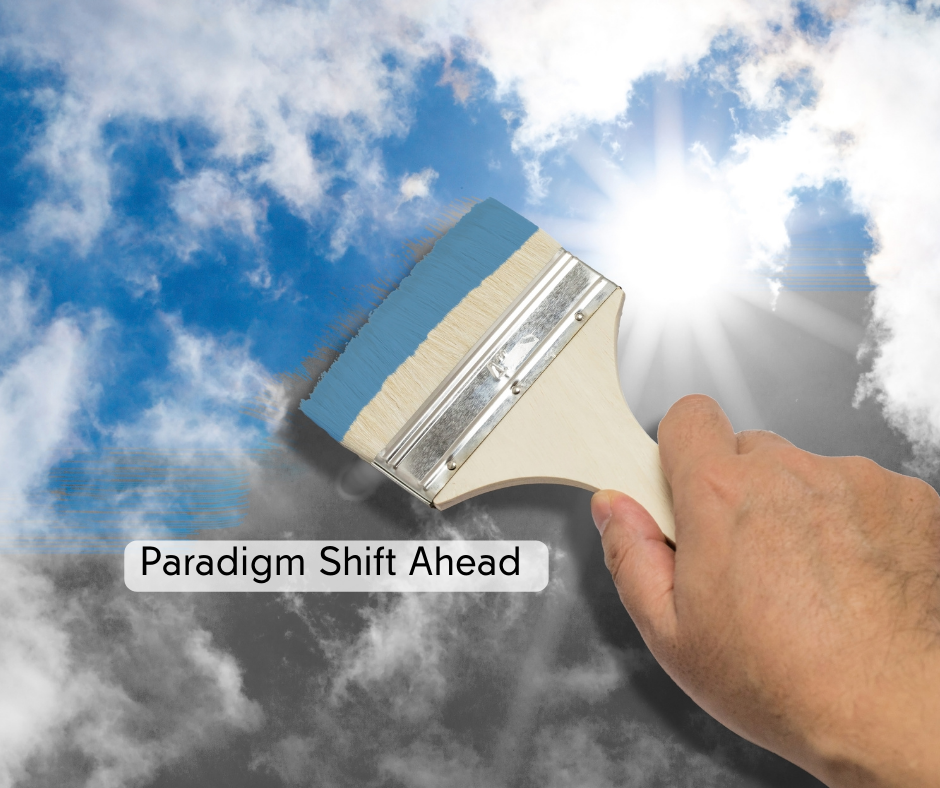
Before we can have a paradigm shift we need to understand what a paradigm is.
Paradigms are often used in science and philosophy to describe a set of concepts, theories, or thought patterns about something. They provide a framework for organizing information, knowledge, and understanding. For example, the earth is round.
Paradigms exist in our own personal life as well and we can simply say a paradigm is a set of thought patterns and beliefs that we hold. They can be a framework or the lens that we view life through.
Here’s some over arching examples of common paradigms:
The world is a dangerous place
Life should be fair
People are generally selfish
Business owners are greedy
Talented people are born that way
People can’t truly change who they are
Paradigms can also be very personal:
I’m not smart enough
Nobody loves me
Bad things always happen to me
My best days are behind me
I would never get a divorce
Paradigms are formed day after day as we live our life. They come from our family, friends, culture, history, religion, how we were raised and even the area of the world we grew up in. Overtime we start to form our own beliefs and we begin to stack up evidence that proves these paradigms. Then we start to live by them. We make decisions based on them. We view life from this lens. They can become engrained into who we are. We often don’t revisit or question them.
But as life unfolds and presents new information and experiences for us, we can find that sometimes the new information doesn’t fit with an existing paradigm. This leaves us with a choice of ignoring the new information and “writing it off” or deciding to explore the new information and asking what am I to do with it.
Shifting away from the paradigms we currently hold can be difficult because they like to show up and tell us of all the reasons why we should keep believing what we do. They like to remind us of all the evidence that they have gathered over the years of our life. They, like us, prefer the comfort zone.
A paradigm shift then is a change in the way we understand or approach our life, circumstances and generally see the world. It involves a shift in our perspective, assumptions, and thinking. This can then result in new discoveries, new thoughts, new behaviors and new results.
Paradigm shifts can happen subtly over time. This may involve questioning long-held beliefs, or seeing a new perspective about something. Sometimes we realize we’ve just been ignoring the evidence in front of us and hoping that something will change on its own.
Other times a paradigm shift may be forced upon us and it can feel like a train just knocked us off the track. Then we find ourself in new experiences (positive and negative) with new information and new thoughts, forming a new paradigm.
Overall, a paradigm shift can play a significant role in who you are and who you’re becoming. They can lead you into the new chapter of your life.
But you have to be willing to change the paradigm so you can free yourself from the old story and create a new narrative about yourself and your life.
A personal example
My father passed away in 2015. After his death my mom felt the need to “lighten the load” when it came to personal belongings and assets. This brought on a lot of work to get rid of a lifetime of stuff. As I helped my mom deal with so many material things, everything from property to high school memorabilia, I came to a new perspective → I was not going to hang onto things that were just collecting dust. But it went much deeper then that.
Within a year of my dad’s death I decided we needed to sell our house. After all most of it wasn’t even being lived in since we no longer had children living at home. I was bent on downsizing and not keeping things for another 20-30 years.
The shift:
I was ready to live a new way. I wanted to start collecting more “life” and less “stuff”. The realization that life is short and time is a commodity became the reason to uproot the way I was living. Most people hang onto their big house because it’s their largest asset, waiting to sell it until retirement or beyond (an example of cultural conditioning). Not me. I had just turned 50 and was ready to trade in the work and expense of maintaining a home for something that provided more freedom in the way of time and money.
Five signs you might be heading into a paradigm shift
One ~ You’re recognizing things in yourself and your life that you don’t like or that no longer serve you.
Two ~ You feel like the old you is disappearing, or being uprooted and that something new is trying to emerge. It’s something deep in your soul that’s calling to you.
Three ~ You feel like you’re fighting something. There’s a resistance to so many things in your day but you can’t really pinpoint the underlying cause for the friction.
Four ~ You’re feeling dull, flat, maybe even numb. You can’t seem to get your passion for life or career back on track. You realize you’re “settling” but don’t know why. You’ve tried to get re-energized but it hasn’t worked.
Five ~ There are endings that are happening in your life, or that need to happen. A career, a relationship, changing family dynamics, or health changes.
Questions you can ask yourself if you think you might need a paradigm shift:
What in my life has shaped this paradigm?
Why do I want to hold onto the “status quo”?
Is there new evidence or experiences that I should consider?
What are my current circumstances trying to tell me?
We are always growing and learning and we live in a world that is ever changing. It’s not easy to recognize our paradigms or what might be causing us to stay in one that’s not really serving us.
If you would like support navigating the changing waters of your your life that’s what I can help with.
The first step is to book a consult call or sign up to receive my monthly newsletter.
Free. Confidential. No judgement. No pressure.
Cheering you on!